

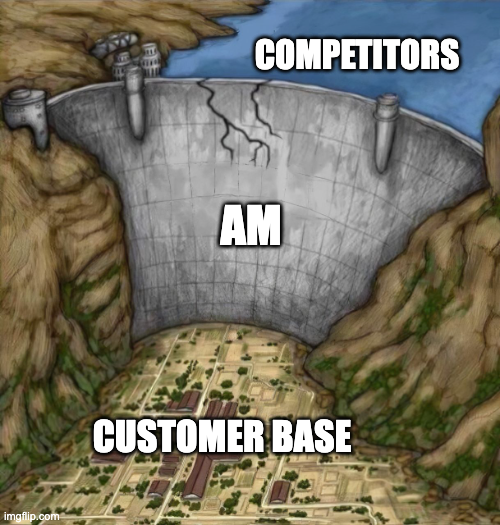
Your competitors are spinning up AI-powered alternatives to your product in months, not years. They're targeting your customers with lower costs, simpler user experiences, and faster implementation. In this rapidly changing market, your competitive advantage isn't just your product anymore—it's how you treat your existing customers.
Yet most companies still don't invest in their account managers (AMs) the same way they invest in new business. This is a critical mistake that's costing you revenue.
In this article, we will analyze the five pillars that drive successful AM enablement, based on insights from Tim Work, Senior Director at Actabl with over 20 years of leading successful sales teams. These actionable strategies will help you transform your account management function from a reactive renewal team into a strategic revenue engine.
According to Tim Work, the market has fundamentally changed. Startups are leveraging AI to build competitive alternatives at breakneck speed. They're actively hunting your customer base with compelling value propositions that are hard to ignore.
In this environment, the way you treat your existing customers becomes your moat. But here's the disconnect: while most companies recognize the importance of customer retention, they still treat account management as a checkbox function rather than a strategic revenue driver.
The old way was reactive contract renewals—waiting until 90 days before a contract expires to re-engage with customers. The new way is strategic revenue expansion, where AMs are actively growing accounts from day one.
Tim puts it simply: "We've got to invest in AM the same way that we invest in new business."
The companies that are winning aren't just protecting their revenue base—they're actively growing it through their AM teams. Here's how they're doing it.
If leadership isn't driving change, your enablement efforts won't stick. It's that simple.
Too many companies treat enablement as a side project run by HR or a small enablement team without executive sponsorship. This approach is destined to fail because enablement requires fundamental changes to how teams operate, and those changes need top-down support.
Before you launch any enablement program, secure commitment from your executive team. This isn't just about budget—it's about creating organizational alignment around the importance of AM as a revenue function.
Your entire go-to-market organization needs to speak the same language. When sales, customer success, and AMs are all measured on different metrics and have different priorities, customers feel the disconnect. Ensure everyone understands how they contribute to customer retention and expansion.
Executive sponsors need to consistently reinforce the importance of the changes you're making. This means talking about it in all-hands meetings, celebrating wins, and holding teams accountable to new standards.
Don't treat enablement as a side project or HR initiative. It needs to be a strategic business priority with dedicated resources and executive oversight.
Tim emphasizes that without proper change management, your enablement program will die within six months. You need C-suite commitment, clear expectations about what's changing, and consistent reinforcement over time.
Old-school AM training focuses almost entirely on renewals and product features. This creates a fundamental problem: you're training your AMs to be reactive support people instead of proactive business advisors.
Modern AMs need to think and act like sellers. They need to understand business value, articulate ROI, and drive strategic conversations with C-suite executives at customer organizations.
Your AMs should be fluent in the language of business value. They need to understand how your product drives outcomes for customers and be able to articulate that value in financial terms. This means training them on discovery techniques, value articulation, and business case development.
Don't silo your AMs away from your sales organization. When sales teams are learning new techniques or discussing deal strategy, your AMs should be in the room. This cross-pollination helps AMs understand the full customer journey and positions them as true partners in revenue generation.
Provide playbooks for upsell and cross-sell motions. Just like your sales reps have playbooks for closing new business, your AMs need structured approaches for identifying expansion opportunities and moving them forward. These playbooks should include discovery questions, qualification criteria, and clear handoff processes.
Don't limit training to product features or renewal checklists. While product knowledge is important, it's not sufficient. Your AMs need to be business advisors first and product experts second.
Don't position AMs as post-sale customer success. While there's overlap between AM and CS functions, AMs should be clearly positioned as revenue-generating roles with commercial targets, not just satisfaction scores.
Quality over quantity wins renewals. Yet many companies still measure AM performance primarily through activity metrics—number of calls made, emails sent, or meetings held.
These activity metrics are lagging indicators that don't actually predict success. What matters is the quality of interactions your AMs are having with customers.
The behaviors that drive retention and expansion are specific and measurable. Are your AMs asking the right discovery questions? Are they successfully getting meetings with economic buyers? Are they positioning your product in terms of business outcomes rather than features?
Modern conversation intelligence tools make it possible to review actual customer interactions at scale. Use these tools to identify coaching opportunities. When you see an AM miss a chance to explore a pain point or fail to ask for an expansion commitment, that's a coachable moment.
Leverage AI sales coaching platforms to automatically identify key moments in calls, track talk-time ratios, measure the quality of discovery questions, and flag missed opportunities. This data-driven approach to coaching is far more effective than relying on subjective assessments or activity volume.
Don't just measure activity volume. Calls made and emails sent are easy to track, but they don't tell you whether your AMs are having high-quality conversations that drive outcomes.
Tim explains that these are lagging indicators that don't predict success. Instead, focus on leading indicators like the quality of discovery, the level of executive engagement, and the depth of business value discussions.
Renewal isn't a deadline—it's a journey that begins the day the deal closes.
Too many companies treat renewals as a discrete event that happens 90 days before a contract expires. By that point, if there are problems in the relationship, it's often too late to fix them. The most successful AM organizations build renewal momentum from day one.
Don't wait until after onboarding is complete to introduce the AM. Bring them into the relationship early, ideally during the sales-to-implementation handoff. This creates continuity for the customer and allows the AM to build rapport during a critical phase.
Don't wait for problems to emerge before getting on the calendar with customer executives. Schedule quarterly business reviews or strategic planning sessions proactively. These conversations should focus on outcomes and business value, not product features or support issues.
Map out the customer journey and identify critical moments where you can validate value and strengthen the relationship. This might include successful go-lives, achievement of key metrics, expansion of user adoption, or integration with other systems. Celebrate these moments with customers and use them to build momentum toward renewal.
Don't wait until 90 days before renewal to re-engage. By that point, any relationship issues have likely festered, and you're in a weak negotiating position.
Don't let customer success managers handle adoption alone. While CSMs play a critical role in driving product adoption, AMs need to be engaged throughout the customer lifecycle to identify expansion opportunities and build executive relationships.
AI isn't optional anymore—it's table stakes. The sellers and AMs who embrace AI tools will outperform those who don't. It's that simple.
According to Tim, your competitors are already using AI, and they're winning because of it. The question isn't whether to integrate AI into your enablement program, but how to do it effectively.
Make it culturally acceptable—and even expected—for your team to use AI tools like ChatGPT, Gemini, and conversation intelligence platforms. Leaders should talk openly about how they're using AI and share best practices across the team.
AI tools can dramatically improve efficiency and effectiveness across the entire AM workflow. Use AI to research accounts before calls, generate personalized follow-up emails, identify patterns in customer conversations, and develop account growth strategies. Provide specific training on these use cases rather than leaving adoption to chance.
Don't let AMs work in silence about AI usage or pretend they don't need it. Some AMs may be hesitant to admit they're using AI tools, fearing it might make them look less competent. Create a culture where AI usage is celebrated, not hidden.
Tim emphasizes that your competitors are using AI and winning. If you're not training your team to leverage these tools effectively, you're putting them at a competitive disadvantage.
None of these five pillars work without proper change management. Tim is emphatic about this point: "Without change management, your enablement dies in six months."
You can have the best training content, the most sophisticated AI tools, and perfectly designed playbooks, but if you don't manage the organizational change effectively, adoption will fail.
C-suite commitment. Leaders need to consistently reinforce why these changes matter and hold teams accountable to new behaviors.
Clear expectations of what's changing. People need to understand specifically what behaviors are changing, why they're changing, and how success will be measured.
Consistent reinforcement. Change management isn't a one-time event—it's an ongoing process. Plan for regular reinforcement through team meetings, coaching sessions, and leadership communications.
Make it cultural, not a one-time event. The most successful enablement programs become part of how the organization operates, not a temporary initiative that fades after the initial excitement wears off.
The market has changed, and companies that continue to underinvest in account management will lose customers to competitors who treat them better. Building world-class AM teams isn't about working harder—it's about working smarter with the right strategy, training, and tools.
Tim Work's five pillars provide a proven framework for transforming your AM function from a cost center focused on preventing churn into a revenue engine that actively grows your customer base. The companies that implement these strategies systematically will have a significant competitive advantage in today's fast-moving market.
Remember, your competitive moat isn't just your product anymore—it's the relationships you build and the value you deliver to existing customers over time. Invest in your AM team accordingly.
In this episode of SellMeThisPen Podcast, Michael and Tim dive deep into the five pillars that drive successful account management enablement. They discuss how the market has changed with AI-powered competitors, why most companies underinvest in their AM teams, and what it takes to build a world-class AM organization that drives strategic revenue expansion.
Tim Work is a Senior Director at Actabl and an innovative sales leader with over 20 years of leading successful teams. His expertise is in growing customer base, driving cross-functional collaboration, and developing solutions that foster long-term client success.


